
Psilocybin Journey Playlist: How Music Guides Your Experience

Music moves you and moves through you. That’s one reason sound is such powerful medicine during a psilocybin journey.
Music can feel like another facilitator in the room: attuned, responsive, & devoted to your healing.
Music runs in my family. My grandmother could hear a song once and then play it on the piano from memory, and my dad sang and played guitar and harmonica. Growing up in that environment shaped how I listen for emotional currents in music, and it’s part of why I put so much care into curating your playlist.
When I design your psilocybin journey playlist, I think of it as your Hero’s Journey Playlist—the soundtrack of your soul. It’s meant to carry you through an inner adventure that’s challenging, beautiful, and deeply alive, helping you meet yourself with more honesty, compassion, and courage.
Why Psilocybin Journey Music Matters
Clinical research confirms what many journeyers already feel: music is not background; it’s a “hidden therapist.” In psilocybin‑assisted therapy for depression, the way people relate to the music—how supported, guided, and emotionally moved they feel by it—has been shown to predict emotional breakthroughs and symptom improvement.
Music has the power to influence mood, regulate your energy, shape your sense of safety, and open doors into emotional material that might otherwise stay protected. In psychedelic work, music becomes a helpful guide, gently steering attention, amplifying what wants to be felt, and helping the brain re‑organize around new insights.
In psychedelic research, music under substances like LSD or psilocybin has been shown to deepen emotional processing, support meaning‑making, and leave lasting changes in brain networks involved in memory and emotion.
Studies suggest that psychedelics heighten the brain’s emotional and sensory response to music, amplifying imagery, memory, and meaning. When music is carefully chosen, it can help create mystical‑type experiences—moments of deep unity, love, and spiritual insight—that are associated with positive change.
Because of this, I treat music as a central part of your therapeutic container.
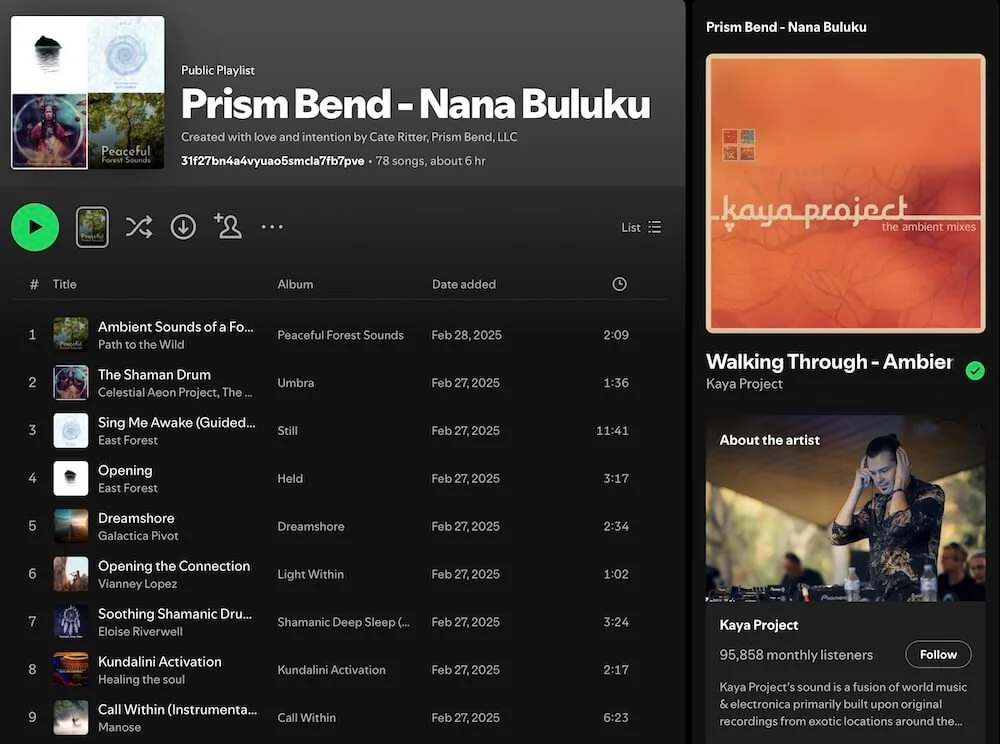
How I Create Psilocybin Journey Playlists
My approach is informed by research and direct experience. Clinical teams led by Dr. Robin Carhart‑Harris and colleagues have shown that emotionally resonant, phase‑based music can deepen psilocybin‑assisted therapy, with music acting as a key driver of mystical‑type experiences.
Every licensed psilocybin journey I facilitate includes a personally curated Spotify playlist. While there are core tracks I return to, I adapt the playlist based on your history, intentions, and our work together.
My sound therapy background shapes how I choose instruments, tempos, emotional arcs, and silence.
I not only want the playlist to sound beautiful, but help to get to the root of what you’re working with. I think of your Psilocybin Journey Playlist as your Hero’s Journey Playlist—a scored story with five phases:
Phase 1: Entering the Sacred (~ 30 minutes)
Here I start with an East Forest Guided Meditation to help you drop into your journey. Then, I select gentle, grounding pieces—often ambient, acoustic, and nature‑based—to signal safety and help you arrive.
You’re invited to breathe, soften, and set clear intentions as the music quietly opens the doorway into non‑ordinary consciousness.
🎵 Call Within by Manose
Phase 2: Ascending (~ 60 minutes)
As the medicine comes on, I introduce more textured and dynamic tracks. These pieces have deeper rhythms and richer layers that help shake things up, allowing emotions, memories, and sensations to move.
The goal is not to support whatever surfaces in a held, intentional way.
🎵 First Steps by Abbott
Phase 3: Peak / Expansive (~ 120 minutes)
At the peak, music becomes spacious, powerful, and archetypal. I work with deep ambient, orchestral, and carefully chosen cinematic pieces that can hold grief, awe, surrender, and revelation.
This is the heart of your Hero’s Journey, where you may meet shadow, receive insight, or experience profound love.
🎵 Journey of a Lifetime by Tom Benscher
Phase 4: Coming Back (~ 60 minutes)
As intensity softens, I shift toward warmer, melodic, heart‑centered tracks.
Gentle piano, strings, and ambient music help you integrate, come back into your body, and start to understand the story unfolding.
🎵 Across the Mountains by Omar Raafat
Phase 5: Grounding & Closing (~ 90 minutes)
Closing music is grounding, and nurturing. This is where we land: with tracks that say “you’re safe, you did it, you can rest.”
Here, I transition into nature sounds and soft ambience as your attention returns and you prepare to nourish your body and rest.
🎵 The Creek & The Rain by Wolfgang Ohmer
Within this structure, I choose specific songs and instrument combinations that support emotional work—whether that means more strings for heart‑opening, deeper drones for somatic release, or gentler textures for those with trauma.
Sound Therapy
In addition to music, I may offer light sound therapy support through Zen singing bowls, crystal bowls, chimes, tuning forks, or other therapeutic instruments. Any sound work is discussed in advance and used only with clear consent.
Integrating With Music
After your journey, I send your playlist so you can continue working with the music in your own time. Listening can gently re‑activate the emotional landscapes and insights, giving your nervous system another chance to process and integrate.
Because psychedelics temporarily increase neuroplasticity, returning to the same music after your session can act like a cue that re‑opens that learning window. The songs become anchors for key moments in your journey, helping your brain learn new perspectives and patterns.
A Client’s Reflection on his Playlist
In this clip from my post-journey interview with Matt, he shares how the music supported his journey and why listening to the playlist during integration helped him anchor in his experience.
Birdsong, Nature, and Silence

One of my favorite ways to support clients, both during and after the journey, is through birdsong and nature sounds. Research suggests that listening to birds can reduce anxiety and depression, supporting mood and self‑regulation because birdsong signals “environmental safety” to the nervous system. Forests, ocean waves, and other natural soundscapes have also been linked with stress reduction and improved attention.
In journey work, natural sounds can:
Ground you when your inner experience becomes intense.
Deepen your sense of connection with the living world.
Create a bridge between the journey and the nature around you in daily life.
Even a few minutes outside, simply listening to birds and the wind, can remind your body of the calm and clarity you experience during your journey.
Silence is another part of the playlist. Thoughtfully placed pauses give your system time to digest what has arisen, allowing emotions and insights to settle.
Many people discover that in the quiet, they hear their inner guidance.

ABOUT THE AUTHOR
Cate Ritter is a Licensed Psilocybin Facilitator and Transformational Coach in Bend, Oregon. Drawing on years of experience in sound therapy, Cate personally curates every psilocybin journey playlist. She carefully selects and sequences music, nature sounds, and silence to support emotional processing, nervous‑system safety, and deep inner transformation.
Her work blends research with intuitive, heart‑centered care, helping clients feel held, seen, and empowered.
DISCLAIMER: This information is provided for educational purposes only and should not be considered medical, mental health, or legal advice.